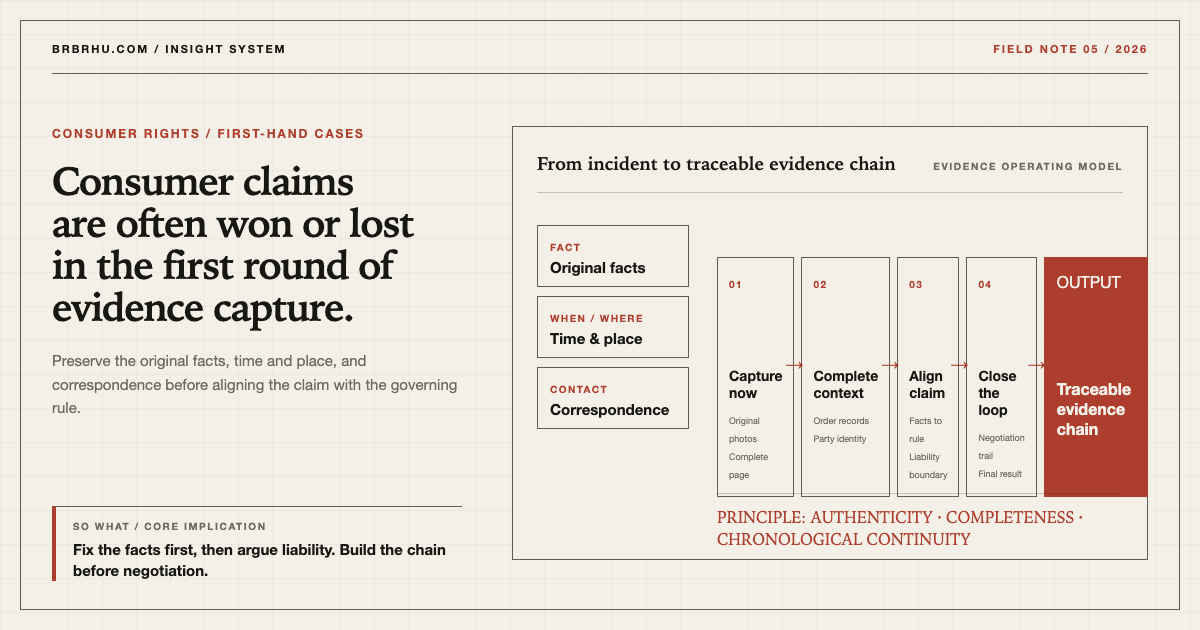
I used to ask whether it was worth pursuing a dispute over a few dozen or a few hundred yuan. A consumer may certainly decide to let something go, but that choice should be made after seeing the facts and cost—not imposed by a seller’s statement that replacement is the only option.
Consumer action should not begin by raising the volume. It should begin by keeping the evidence unchanged and stating the requested remedy clearly.
01 / FOOD SAFETYA foreign object in a birthday cake: preserve first, negotiate second.
I once paid RMB 188 for a birthday cake and found a moth on it immediately after opening the box. Instead of throwing it away or arguing only through chat messages, I froze the cake to preserve its condition and photographed what I had found.
I first asked the seller for a refund and compensation. The seller offered only to make another cake. Because a birthday gathering is time-sensitive, replacement no longer restored the purpose of the purchase, and I had lost confidence in the shop’s hygiene. After negotiation failed, I complained to the market-regulation authority.
The matter ended in mediation: the seller refunded RMB 188 and paid RMB 1,000. The reusable lesson is not the number. It is the sequence—preserve the object, photograph it, keep the order and payment, retain the conversation, and only then escalate the complaint.
Object
Do not discard, clean, or alter the item; preserve its condition safely.
Transaction
Keep the order, payment, seller identity, and product description together.
Communication
State the remedy and preserve the seller’s response and handling process.
02 / MISLEADING CLAIMSAn online wall clock: compare each claim with the delivered item.
In another purchase, I paid RMB 485 for a wall clock advertised as “pure copper” and backed by a “ten-times compensation for fakes” promise. On inspection, the supposed pure copper was brass, a copper-zinc alloy, and what appeared to be marble was plastic printed with a marble pattern.
The seller accused me of malicious extortion, while the marketplace did not promptly provide usable seller contact details. I preserved the product page, the public promise, the order, the physical differences, and the conversations, then pursued both the seller and the marketplace through litigation.
The three parties eventually settled. An earlier proposal for the marketplace to pay approximately three times the price was replaced by an agreement for the seller to pay RMB 7,500 and issue a written apology. This was an individual settlement, not a promise that every “ten-times” claim produces the same result. It shows why the public statement, delivered item, platform obligations, and settlement terms must each be recorded.
03 / SERVICE FAILUREA cinema projection failure: make the shared fact visible.
During the 2023 Spring Festival, I took my family to a film. The projector was visibly misaligned with the screen. Staff did not resolve the issue despite repeated reports during the showing, so I first photographed the condition in a way that showed the projection and screen together.
After the film, I raised the issue publicly and learned that many other viewers had noticed it. I brought more than ten of them into the conversation with the cinema manager. Within about ten minutes, the cinema issued four signed tickets reusable within one month.
The tickets were not worth much. What mattered was that multiple consistent accounts, photographs, and immediate discussion turned a supposedly subjective complaint into a shared fact.
04 / WORKFLOWA repeatable escalation sequence.
- Stop the evidence from changing: preserve the object, original files, product page, and scene.
- Complete the transaction identity: retain orders, invoices, payments, business names, and contact information.
- State the remedy as an action and amount: refund, replacement, compensation, apology, or repair—not merely “give me an explanation.”
- Allow a reasonable opportunity to resolve it: record when and where the request was made and how the seller responded.
- Choose the relevant complaint authority: food, market transactions, prices, and service quality may require different channels.
- Evaluate litigation last: confirm the defendant, jurisdiction, evidence, limitation periods, and cost.
05 / USEFUL EVIDENCEWhat makes evidence useful.
“I took a photo” is not the same as preserving proof. Useful evidence should show what the item or event was, when and where it occurred, who supplied it, how it connects to the transaction, and whether the original file remains intact.
Online product pages can change, so record the full page or screen and retain the order link. A scene photograph should show spatial context, not only a close-up. A conversation should preserve the other party’s identity, surrounding messages, and time. Physical objects should not be cleaned, dismantled, or discarded in a way that weakens their evidential value.
If testing, appraisal, or platform intervention becomes necessary, keep the original and a transfer record. Different disputes require different forms of proof; the higher the value and complexity, the less safe it is to rely on a few cropped screenshots.
06 / LEGAL LIMITSCompensation rules are not automatic.
Article 148 of the Food Safety Law provides for loss compensation, ten times the purchase price or three times the loss in qualifying food-safety matters, with a minimum additional amount of RMB 1,000. Application still depends on whether the food failed safety standards, the producer or seller’s position, the consumer context, and the evidence. The statute also contains an exception for harmless labelling defects that do not mislead consumers.
Article 55 of the Consumer Rights Protection Law provides for three times the purchase price or service fee, with a RMB 500 minimum, where the trader has committed fraud. Article 44 addresses the responsibility of an online marketplace that cannot provide a seller’s real name, address, and valid contact details.
These provisions are not calculators that automatically turn an order value into a compensation award. Fraud, responsibility, the marketplace’s performance of its duties, and the meaning of a voluntary promise all depend on the particular facts. My experiences offer a method, not a guaranteed outcome for a new case.
Sources and verification
- The original public WeChat essay from 没事多吃核桃.
- Food Safety Law of the People’s Republic of China, especially Article 148.
- Law of the People’s Republic of China on the Protection of Consumer Rights and Interests, especially Articles 44 and 55.
- Supreme People’s Court Interpretation (I) on civil food-safety disputes.
- This is general information and a first-hand practice note. It does not guarantee the same outcome in a similar dispute and is not formal legal advice.
Turn one dispute into a method that survives the next one.
Legal practice does not happen only in court. It begins when you preserve a photograph, define a remedy, and refuse to let the facts quietly disappear.
Continue through Legal Practice
READER COMMENTS
Leave the thought this article gave you.
No comments yet. You can leave the first one.