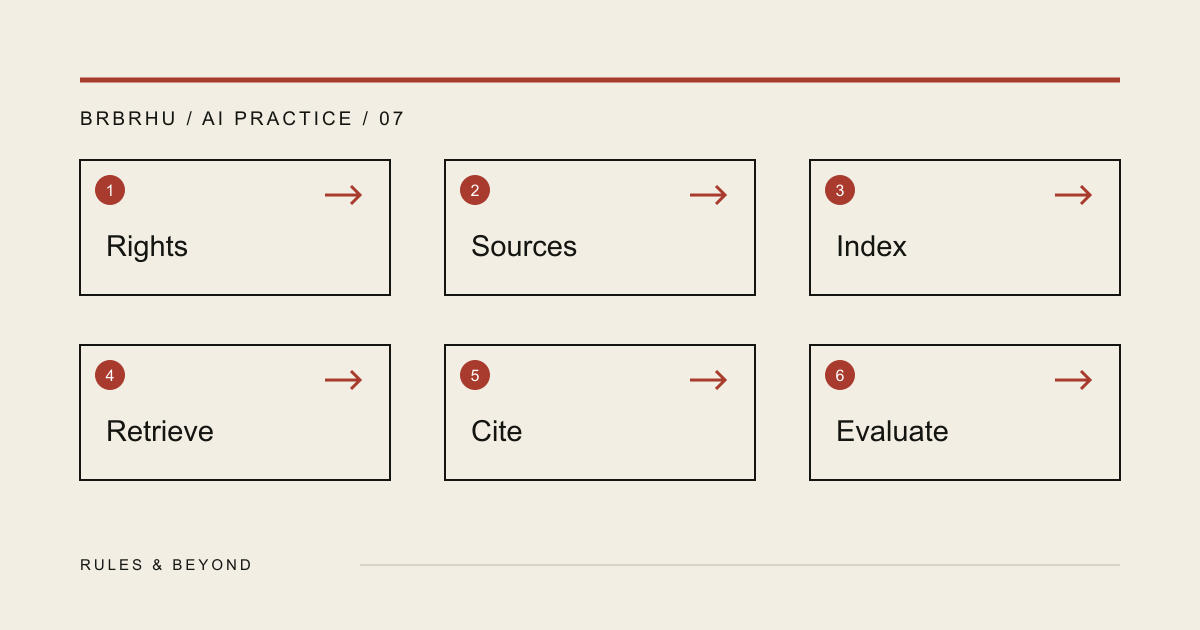
An archive becomes useful when the system can locate the right passage for a concrete situation, explain how it supports a recommendation, and reveal both the licence boundary and the limits of the evidence.
01 / RIGHTS FIRSTUse only owned, licensed, or genuinely public material
Possessing a file is not the same as having the right to reproduce, transform, train on, redistribute, or sell it. Record the source and allowed uses before indexing.
- Owned: your interviews, memos, transcripts, and original research.
- Licensed: material whose terms allow the intended storage and use.
- Public: material lawfully available under terms compatible with your purpose.
- Excluded: leaked, scraped against terms, or purchased for personal reading but repackaged for resale.
02 / PERMISSION LEDGERGive every document a rights and provenance record
Store author, origin URL, acquisition date, licence or permission, permitted audience, expiry, and removal route. Keep this ledger separate from the document text so it can govern retrieval.
03 / SOURCE INDEXIndex claims and scenarios, not only documents
Split material around coherent ideas. Attach speaker or author, date, topic, scenario, evidence type, and a stable pointer to the original passage.
source_id:
title:
author:
source_url:
licence_or_permission:
published_at:
scenario:
claim:
evidence_type:
exact_location:
confidence:
reviewed_by:
expires_or_review_on:
04 / SKILL LAYERSSeparate retrieval, analysis, writing, and decisions
A single “act like a consultant” prompt hides too much. Build small skills with explicit inputs and outputs.
- Research skill: finds relevant authorised passages and returns citations.
- Analysis skill: compares options and labels assumptions.
- Writing skill: formats the result for a named audience.
- Decision skill: proposes options but escalates material commitments to a person.
05 / TRACEABLE OUTPUTMake every material recommendation inspectable
Return the recommendation, supporting sources, counter-evidence, assumptions, confidence, and what new fact would change the answer. If no authorised source supports it, say so.
A useful consultant skill can answer “why this?” without inventing authority.
06 / EVALUATE AND WITHDRAWTest difficult cases and honour removal
Evaluate ordinary scenarios, ambiguous requests, conflicting sources, outdated material, and requests outside permission. When a source is withdrawn or expires, make it disappear from retrieval and re-run affected evaluations.
- Citation accuracy.
- Permission compliance.
- Correct refusal and escalation.
- Stability across repeated runs.
- Ability to remove one source completely.
Rights boundary and official skill guidance
- OpenAI — Build skills — Official guidance for packaging reusable instructions and resources.
- OpenAI Plugins — Official examples and current plugin repository.
- Original public discussion — The archive-to-skill idea, separated here from any unauthorised resale of paid material.
Begin with ten sources you are unquestionably allowed to use.
A smaller lawful corpus with precise citations beats a larger archive whose origin you cannot defend.
Back to the field guide Review the team knowledge base
READER COMMENTS
Leave the thought this article gave you.
No comments yet. You can leave the first one.