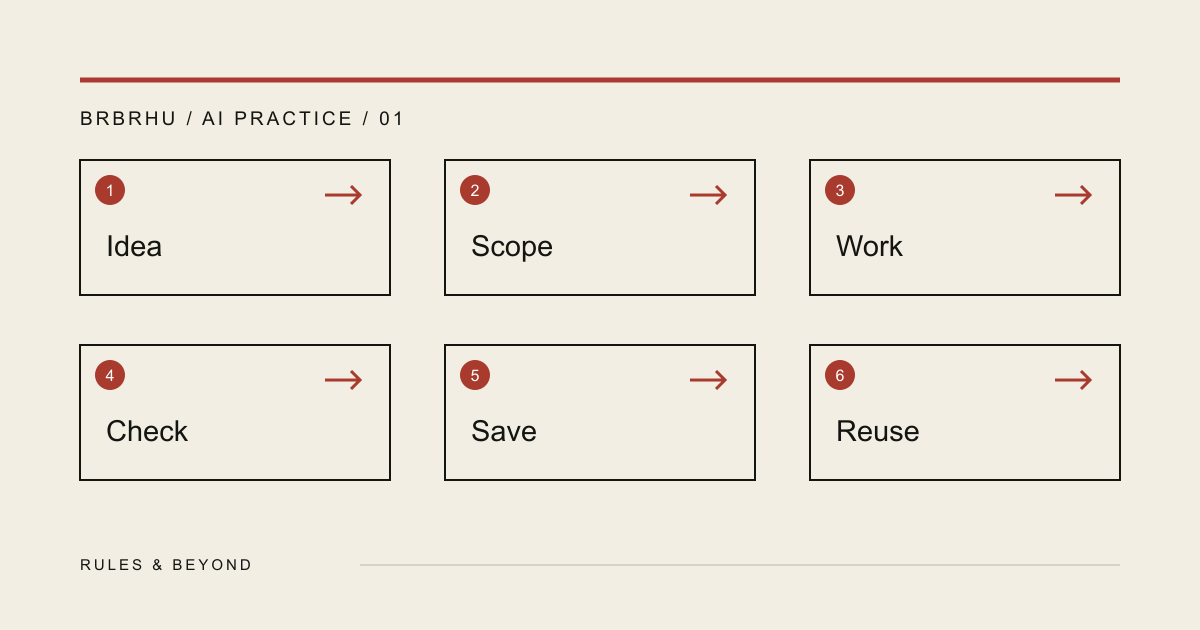
A bookmark stores possibility. A workflow specifies when the idea should be used, what it needs, what counts as done, and what must be checked. Without that operating layer, even an excellent prompt is only a one-off demonstration.
01 / THE SAVED-IDEA TRAPWhy more bookmarks can make action harder
Social posts compress the invisible work. They show the finished knowledge graph, polished image, or fluent conversation, while omitting input cleaning, failed attempts, source checking, and permission boundaries.
To recover the method, remove exaggerated claims and answer four questions: what problem is solved, what inputs are required, how the result is verified, and how failure is handled.
A technique becomes a method only when another person can understand it, finish a small version today, verify the result, and find it again.
02 / SIX REUSABLE STRUCTURESBuild the loop, not just the prompt
A strong prompt improves the first instruction. A reliable workflow also makes intermediate states visible and records what happened.
- Scope — name the user, purpose, constraints, and completion signal.
- Steps — split a large request into observable actions.
- Verification — return claims to original sources and actions to visible end states.
- Record — preserve sources, dates, versions, edits, and failure reasons.
- Reuse — turn stable choices into a checklist, template, or schema.
- Iteration — change one variable at a time and compare the outcome.
03 / SIX STARTING ROUTESChoose the bottleneck you actually have
The series now covers six situations: research that disappears after one chat; team knowledge trapped in people’s heads; language practice without correction; visual work blocked by generation time; daily information overload; and large archives that cannot yet support accountable advice.
- Research → a searchable second brain.
- Experience → a verified team knowledge base.
- Conversation → a fifteen-minute language practice loop.
- Image generation → an asynchronous production pipeline.
- Feeds → a bounded intelligence brief.
- Authorised archives → a traceable consultant skill.
04 / UNIVERSAL WORK ORDERRewrite any new trick as a real task
Use a short work order before copying a prompt. It makes missing evidence and risky actions visible early.
OUTCOME
Create [specific deliverable] for [real user and use].

INPUTS
Use only [files, links, data]. Mark missing information as unverified.

PROCESS
Ask up to five critical questions. Show intermediate results.

ACCEPTANCE
Meet [format, length, date, sources, accessibility]. Separate fact, inference, and unknown.

CONTROL
Pause before publishing, sending, deleting, paying, or exposing private data.

REUSE
Return the final template, failure points, and one improvement for next time.
05 / THIRTY-MINUTE TESTComplete one minimum loop today
Pick one saved technique you genuinely wanted to use. Limit the first attempt to thirty minutes and one visible artifact.
- State the real problem without saying only “improve efficiency.”
- Ask for sources or intermediate output and verify at least one item yourself.
- Save the successful steps, the failure, and the final template in a fixed place.
- If you finish with only a chat transcript and no inspectable change, the loop is not complete.
06 / EVIDENCE AND BOUNDARIESPublic experience is a lead, not proof
The routes begin with public practice and then return to official documentation or primary material. A compelling individual result does not establish universal reproducibility.
- Check quotations, numbers, product capabilities, and dates at the primary source.
- Minimise or remove client data, personal data, and confidential business information before using a cloud model.
- AI may organise and remind; a person remains responsible for publication, payment, legal judgment, and external commitments.
Six practical routes
- Route 1 — Second-brain workflow — Turn cited research into retrievable knowledge.
- Route 2 — Team knowledge base — Structure facts and approval boundaries before automation.
- Route 3 — Language coach — Use retry and recurrence, not conversation time, as evidence of learning.
- Route 4 — Visual pipeline — Move generation latency off the critical path.
- Route 5 — Daily intelligence brief — Reduce information into decisions and honest limits.
- Route 6 — Consultant skill — Make advice traceable to authorised sources.
Start with one situation you will genuinely use today.
The smallest completed loop teaches more than another hundred saved prompts.
Begin with research Build a daily brief
READER COMMENTS
Leave the thought this article gave you.
No comments yet. You can leave the first one.