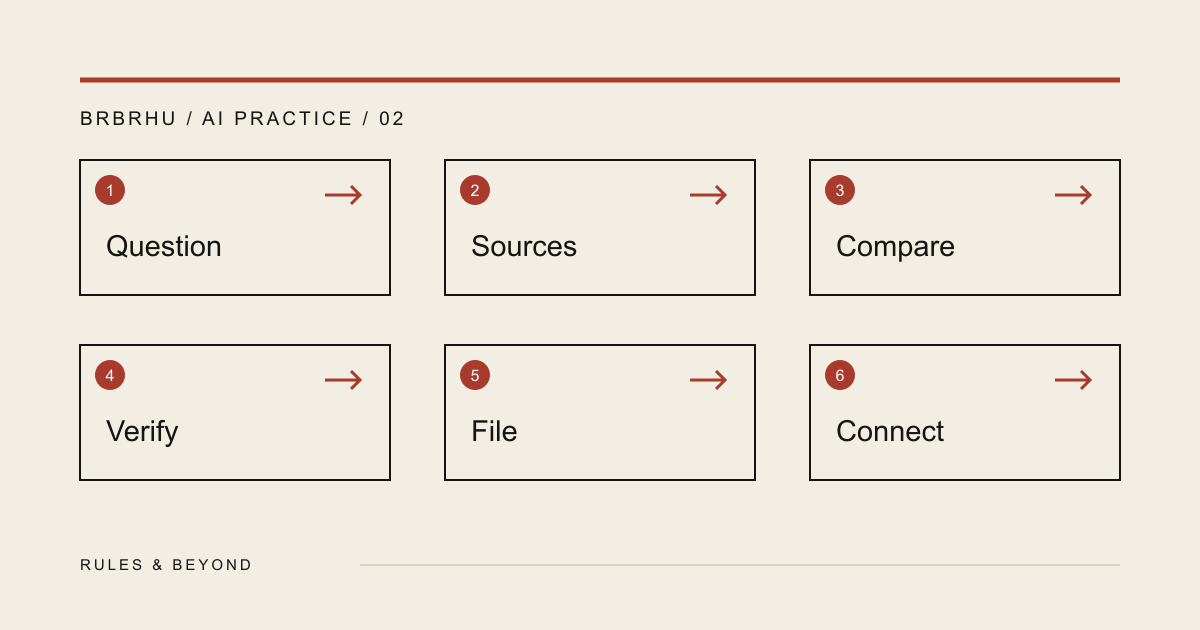
A second brain is not a warehouse of transcripts. Its value comes from retrieval and traceability: where a claim came from, when it was valid, what it connects to, and how the next task can reuse it.
01 / DEFINE THE OUTCOMEDecide what the research must leave behind
Replace “research this industry” with an object, region, time range, purpose, output form, and evidence boundary.
- Object and time range.
- Real use: article, decision, meeting, or orientation.
- Output: findings, comparison, timeline, risk list, or source index.
- Boundary: preferred sources, uncertainty rules, and cut-off date.
02 / RESEARCHLet AI search, but do not let it believe for you
Ask the system to separate facts, inferences, and recommendations; retain contradictory evidence and unknowns; and show where each critical statement came from.
Research [topic] in [region and period] for [real use]. Return key findings with evidence strength, opposing views with primary sources, unresolved questions, and next actions. Prefer official files, original data, and first-hand material. Attach an openable source to every factual conclusion.
03 / VERIFYOpen the primary sources
You do not need to repeat the entire investigation. Perform a minimum audit of the claims on which your decision depends.
- Numbers: value, unit, year, and denominator match the source.
- Quotations: surrounding context does not reverse the meaning.
- Recency: the page predates or postdates the research cut-off as expected.
- Advice: clearly label whether it comes from a source or from model inference.
04 / FILEUse a small set of durable properties
Store a searchable title, created and updated dates, a verification status, the main source, and two or three stable tags. Use only draft, checked, and verified for status.
---
title: "Research topic: searchable conclusion"
created: 2026-09-08
updated: 2026-09-08
status: checked
source_type: deep-research
source_url: "primary source"
tags: [ai-research, topic]
---

## One-sentence conclusion
## Key evidence and verification state
## Opposing views and unknowns
## What this changes for me
## Next action
05 / LINKConnect the note to future work
Create links to the broader topic, the project this research supports, and a note that conflicts with or complements it. Links are useful as future entry points, not as decoration for a graph.
06 / REUSE TESTTest the system one week later
Without opening the original chat, find the note within thirty seconds, travel from a key claim to its primary source, and reuse a passage while knowing whether it is still current.
If it cannot be found, checked, or used, you saved a file—not a piece of knowledge.
Inspiration and primary documentation
- OpenAI — Deep research — How multi-step research and cited reports work.
- Obsidian — Properties — Official reference for structured note properties.
- Obsidian — Internal links — Official reference for connecting notes.
Use one real question before migrating an archive.
Complete one research run, verify three sources, and see whether you can retrieve it next week.
Back to the field guide Next: team knowledge base
READER COMMENTS
Leave the thought this article gave you.
No comments yet. You can leave the first one.