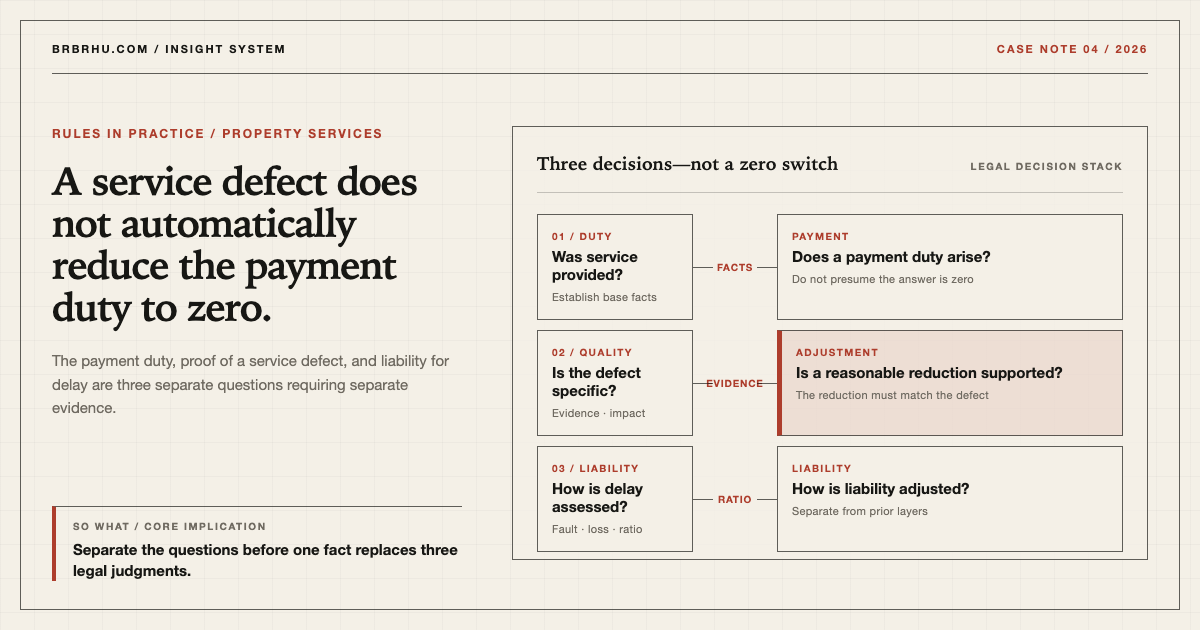
Property-management disputes often begin with two broad claims. The owner says the estate was poorly managed and refuses payment; the service company says work continued and every sum claimed must therefore be paid. In litigation, the court returns to the contract, actual performance, and evidence rather than accepting either general impression.
A defect in service does not automatically reduce every fee to zero; an outstanding fee does not automatically make every claim by the service provider recoverable.
01 / FACTSWhat happened.
A property-management company and an owner, referred to here as Liu, entered into a Property Management Service Agreement in 2019. Liu did not pay the agreed fees from November 1, 2020 through February 28, 2023.
The company calculated RMB 4,640 in unpaid fees and also claimed late-payment damages, making a total claim of RMB 6,032. It sued after repeated demands went unanswered.
Liu argued that, despite purchasing an underground parking space, the company had not separated pedestrian and vehicle traffic and had otherwise managed the estate poorly.
02 / DECISIONHow the court dealt with it.
The court treated the agreement as valid. It did not provide that buying an underground parking space reduced the management fee, nor did it expressly make pedestrian-and-vehicle separation one of the company’s contractual duties. That argument therefore did not extinguish Liu’s payment obligation.
The judgment awarded RMB 4,640 in unpaid fees but rejected the claim for late-payment damages. It also recognised that the service still required improvement and emphasised disclosure, good faith, and a stable relationship between the service provider and owners.
Neither side appealed. The company also took the reasonable feedback raised during the dispute into its continuing service improvements.
Contract
The valid agreement remained the starting point.
Fees
The evidence did not justify extinguishing RMB 4,640 in fees.
Damages
The separate claim for late-payment damages was not allowed.
03 / TWO-SIDED RULESThe rule has two sides.
Article 943 of the Civil Code requires a property service provider to disclose, at reasonable intervals, the services, responsible personnel, quality requirements, charges, performance, use of maintenance funds, and income generated from common areas.
Article 944 also requires owners to pay agreed fees. Where services have been provided in accordance with the agreement and applicable rules, an owner may not refuse payment merely because the owner did not personally use or need those services.
Read together, the provisions set a two-sided boundary. A service provider cannot use the payment duty as a substitute for disclosure and service improvement. An owner cannot use a broad expression of dissatisfaction to erase every contractual duty. The agreed scope, duration and seriousness of a defect, notices to remedy it, and time-and-place-specific evidence all matter.
04 / EVIDENCE FOR OWNERSHow owners can preserve evidence.
- Begin with the agreement: identify the scope, standards, charges, and any specific promises.
- Fix time and place: photographs and videos should identify the date, building, area, and problem; keep originals.
- Create a remediation trail: retain complaints, submission channels, and responses from the company or owners’ committee.
- Separate isolated faults from persistent failure: they do not carry the same evidential weight.
- Limit further loss: report urgent safety, fire, or water issues and take reasonable protective steps.
- Do not assume the result is zero: obtain advice on the particular contract before arrears continue to grow.
05 / SERVICE RECORDSHow service providers can reduce disputes.
The strongest response is not simply “we did the work,” but a performance record that can be checked: inspections, cleaning and landscaping plans, repair tickets, staffing, complaint handling, fee disclosures, common-area income disclosures, and payment demands should line up.
Demands should also preserve the deadline, recipient, and delivery method. Even where fees are recoverable, opaque records, unanswered complaints, or mechanically calculated late-payment damages may still affect parts of a claim.
06 / BOUNDARYWhat this case does not prove.
This is not a rule that an owner can never defend a claim once any service has been supplied. It is also not a prediction for another estate, agreement, or evidence record.
This page reports the facts and reasoning of one matter. Service standards, performance, evidence, relief sought, and local rules may differ. Decisions to stop payment, sue, or defend a claim should be made only after reviewing the actual agreement and materials.
Sources and verification
- The original public WeChat case article from 没事多吃核桃; party identities have been removed in this adaptation.
- Civil Code of the People’s Republic of China, especially Articles 943 and 944.
- The NPC Legislative Affairs Commission’s public explanation of property-fee rules.
- This page is general legal information and a first-hand practice note, not formal advice on any specific matter.
A rule becomes useful when it returns to evidence.
Continue with a first-hand account of how three consumer disputes became a repeatable evidence workflow.
Read the consumer evidence note
READER COMMENTS
Leave the thought this article gave you.
No comments yet. You can leave the first one.