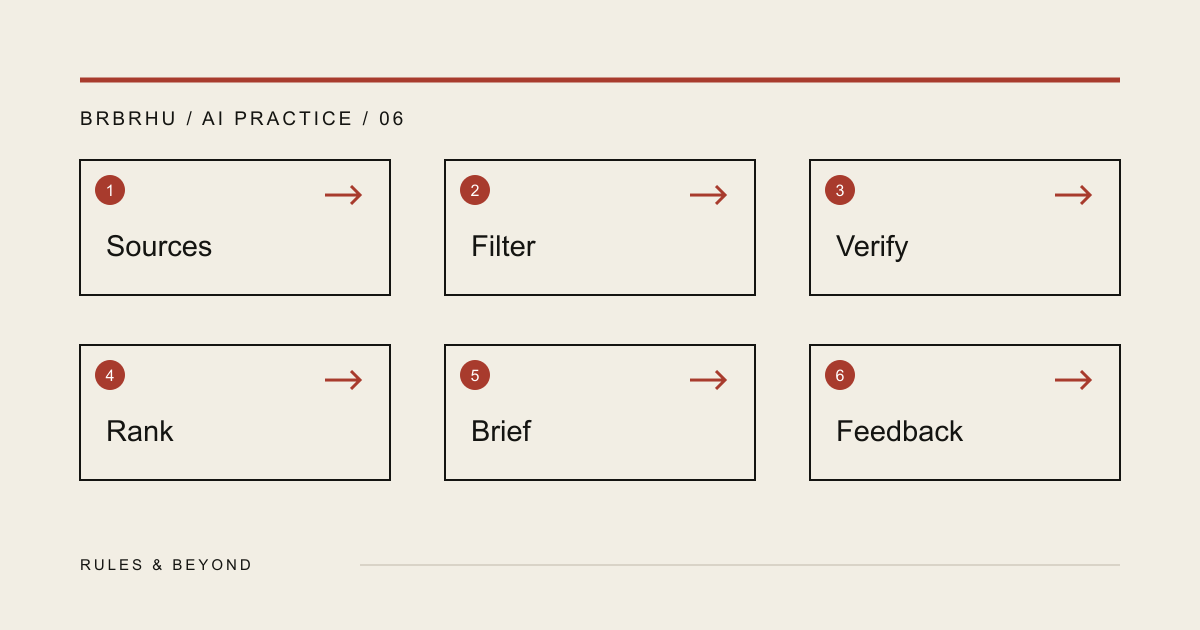
The failure mode of automated monitoring is not only hallucination. It is silent incompleteness: the system reads an unknown slice, misses duplicates, and writes with the confidence of a full survey. A useful brief makes its coverage and limits explicit.
01 / BOUND THE RUNDefine source, window, target, and stopping rule
Use a new, isolated run. Name the exact feed or source list, time window, minimum target, maximum duration, and what to do if the target cannot be reached.
Open a fresh read-only session. Review [named sources] for [time window]. Aim for [target] unique items or stop after [duration], whichever comes first. Record every item by canonical URL, do not like, reply, repost, follow, purchase, or message. Report the actual number reviewed and every access limitation.
02 / DEDUPLICATECount unique evidence, not repeated impressions
Use canonical post or article URLs as identifiers. Collapse reposts and repeated links, but retain meaningful disagreement or new primary evidence.
03 / CLASSIFYUse categories that change what you do next
Avoid vague sections such as “interesting”. Classify by decision consequence.
- Verify: potentially important, but evidence is incomplete.
- Act: credible, relevant, and time-sensitive enough for a concrete next step.
- Watch: not actionable yet, but worth tracking.
- Discard: duplicate, promotional, unsupported, or outside scope.
04 / RANKScore relevance, evidence, novelty, and urgency
A post can be popular but irrelevant, novel but unsupported, or credible but not time-sensitive. Rank those dimensions separately before combining them.
05 / WRITE THE BRIEFLead with signals, evidence, and next action
For each selected signal, state what changed, why it matters to this reader, the strongest available source, uncertainty, and one next action. Link to representative primary items rather than listing everything.
- Coverage: sources, time, unique items, failed access.
- Top signals: evidence and interpretation separated.
- Contradictions and unknowns.
- Verify / act / watch queues.
- Next run: what to widen, narrow, or revisit.
06 / AUTOMATE SAFELYSchedule the bounded task, not unrestricted browsing
Run on a sensible schedule, keep it read-only, limit time and volume, and review failure logs. Never let monitoring silently gain interaction permissions or turn “could not access” into “nothing happened”.
Honest incompleteness is more useful than a confident false sense of coverage.
Original pattern and official context
- OpenAI Academy — Codex automations — Official explanation of scheduled, repeatable Codex work.
- Introducing the Codex app — Official product context for parallel and background work.
- Original public brief — The bounded-reading and honest-reporting pattern adapted here.
Build one brief for one decision, not a universal news machine.
After seven runs, remove categories that never change an action and strengthen sources that repeatedly matter.
Back to the field guide Next: consultant skill
READER COMMENTS
Leave the thought this article gave you.
No comments yet. You can leave the first one.