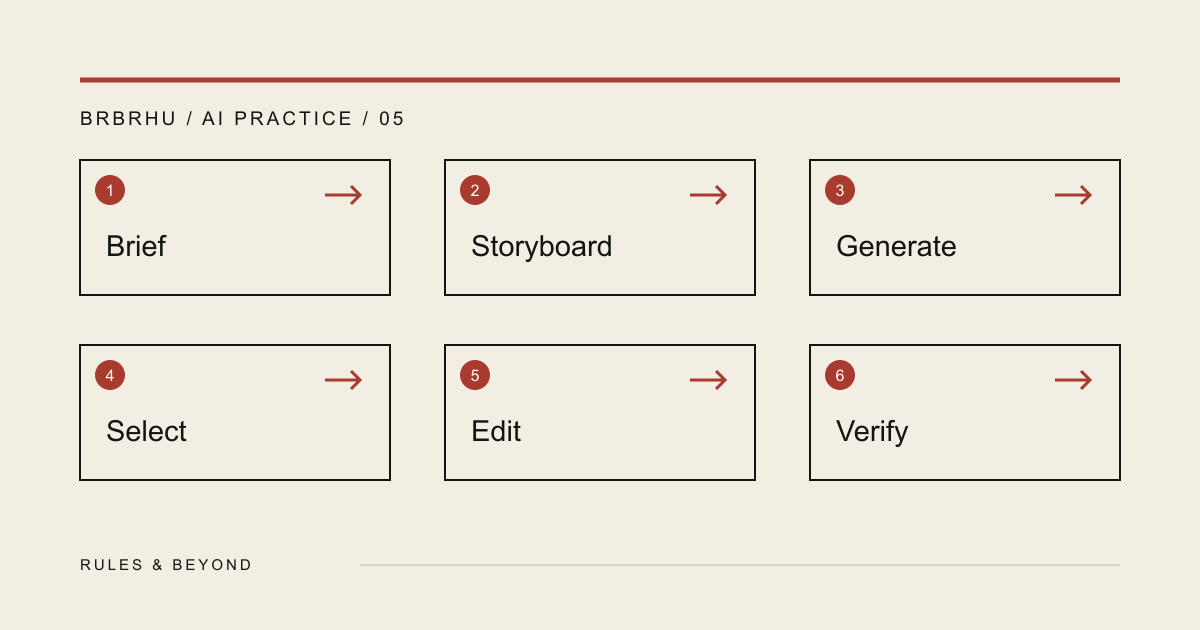
Image generation is naturally slow and uncertain. If every request blocks the main conversation, the creative task controls the entire schedule. A better system separates the main lane from the generation lane and reunites them only when a decision is needed.
01 / BRIEF ONCEFreeze the invariant parts of the brief
Write the audience, placement, dimensions, visual thesis, palette, required facts, forbidden elements, and acceptance tests before generating.
PURPOSE: [where the image appears and what it must communicate]
AUDIENCE: [reader]
FORMAT: 1200 × 630 landscape
INVARIANTS: [palette, visual system, factual elements]
VARIABLES: structure / viewpoint / crop
FORBIDDEN: copied title, fake logos, tiny text, invented data
ACCEPT: clear at phone size, relevant to the argument, no factual error
02 / BATCH BY VARIABLEParallelise meaningful differences, not random variants
Each candidate should test one hypothesis. One changes composition, one changes metaphor, and one changes crop. When everything changes, comparison teaches nothing.
- Structure batch: sequence, matrix, loop, or decision tree.
- Metaphor batch: bottleneck, control plane, ledger, or feedback loop.
- Crop batch: social card, article lead, or narrow mobile detail.
03 / KEEP THE MAIN LANE MOVINGContinue writing, coding, or source checking
Treat image generation as a background job with a stable brief and output location. Do independent work while it runs; collect results only when the next decision actually depends on them.
04 / HUMAN GATESelect against the article’s argument
Reject images that merely repeat the title. The winning image must reveal a relationship the text needs: what causes what, where control sits, what gets filtered, or why a loop improves.
- Meaning: the model matches the article.
- Hierarchy: one insight is visible first.
- Legibility: still clear at phone width.
- Rights: source and licence are known.
- Truth: no invented logo, statistic, or interface.
05 / PROVENANCEStore the brief, tool, date, and human edits
Keep a small manifest beside the final asset. Record which source informed the visual, which generator or renderer produced it, what was changed by a person, and where it is published.
06 / RELEASE CHECKTest the actual context, not the source canvas
Open the article at desktop and 390-pixel mobile widths. Confirm intrinsic dimensions, alt text, social metadata, no horizontal overflow, and acceptable compression. A perfect source file can still fail inside the page.
The pipeline is complete only when the final image works in the reader’s context.
Source and implementation reference
- Esse — Open-source local image workspace and Codex integration; review releases and security notes before installing.
- Original public workflow — The public example that inspired the asynchronous production pattern.
Start with one article and three controlled hypotheses.
The purpose of parallel generation is better judgment, not a larger folder of unused images.
Back to the field guide Next: daily intelligence brief
READER COMMENTS
Leave the thought this article gave you.
No comments yet. You can leave the first one.