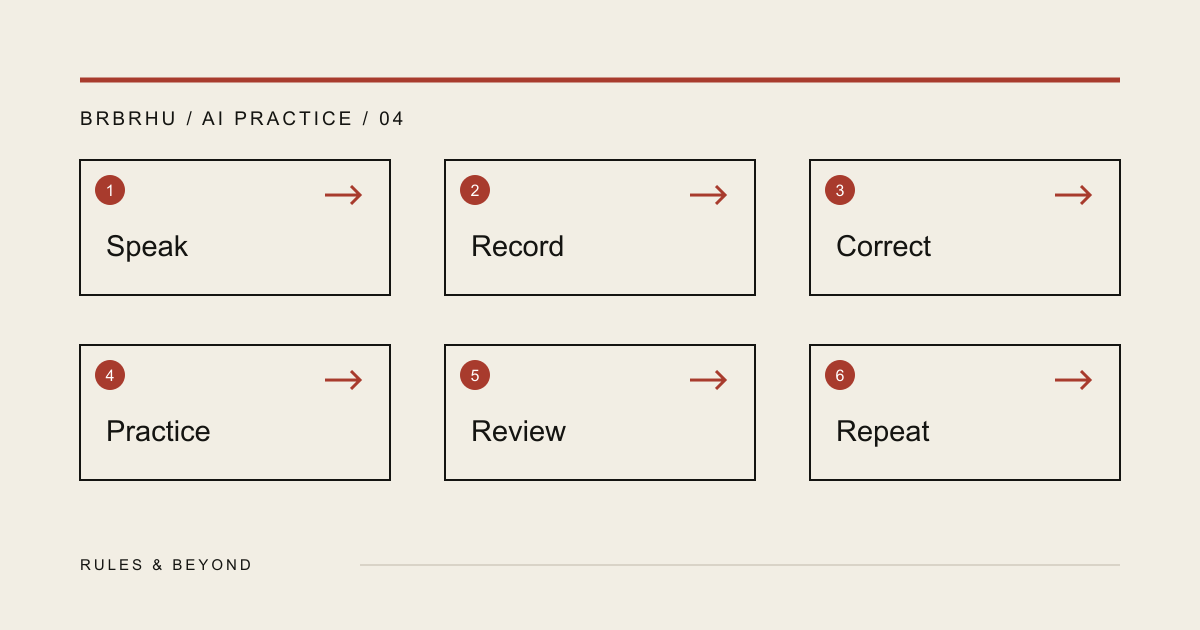
Unstructured voice chat feels productive because it is fluent. Learning becomes visible only when errors are selected, explained, retried, and checked in a later session.
01 / PREPAREChoose one situation and one correction rule
Use a real situation—introducing yourself, asking for an appointment, explaining a problem—and ask the coach to interrupt only for errors that block meaning or repeat.
Act as my [language] speaking coach for one real situation: [situation]. Keep your turns short. Correct only errors that change meaning or repeat. After each correction, give the natural sentence, one brief explanation, and ask me to say it again before continuing.
02 / WARM UPSpend two minutes making speech easy
Answer predictable questions with familiar vocabulary. The purpose is to reduce start-up friction, not to test yourself immediately.
03 / CONVERSEProtect the speaking ratio
Keep the coach’s turns to one or two sentences. If explanations grow, ask for the explanation in text after the oral exchange.
- One topic for five minutes.
- No translation unless communication stops.
- No correction of every article or minor accent feature.
04 / CORRECT AND RETRYMake the corrected form leave your mouth
Reading a correction creates recognition; saying it again trains production. Repeat the full phrase, then use the same structure in a new sentence.
A correction is not complete until you can produce it again without copying.
05 / RECORDKeep only three errors and one next task
Save the original phrase, the corrected phrase, the reason, one new example, and the date. More than three corrections usually becomes a list you never review.
06 / MEASURETrack recurrence, not confidence
At the next session, deliberately reuse the three structures. Count how many return incorrectly. A falling recurrence rate is stronger evidence than a session that merely felt smooth.
- Errors selected today.
- Errors reproduced correctly after correction.
- Errors that returned next session.
- One situation to practise next.
Primary references
- OpenAI — Voice mode FAQ — Official information about voice conversations and their limits.
- Council of Europe — CEFR Companion Volume — Reference for action-oriented language learning and communicative tasks.
Run one fifteen-minute loop before changing tools.
One repeated correction is more valuable than an hour of passive listening.
Back to the field guide Next: daily intelligence brief
READER COMMENTS
Leave the thought this article gave you.
No comments yet. You can leave the first one.