A search box finds pages that already exist. Generative AI organizes an answer from the conversation and the material it can use. It can explain, compare, extract, rewrite, plan and draft, but it does not know requirements you leave implicit. “Write a meeting notice” still leaves who, what, action, deadline and tone unknown. A colleague would ask; AI is simply more likely to fill the gaps with a plausible version.
01 / PRACTICEAI is not a search box or mind reading
A search box finds pages that already exist. Generative AI organizes an answer from the conversation and the material it can use. It can explain, compare, extract, rewrite, plan and draft, but it does not know requirements you leave implicit. “Write a meeting notice” still leaves who, what, action, deadline and tone unknown. A colleague would ask; AI is simply more likely to fill the gaps with a plausible version.
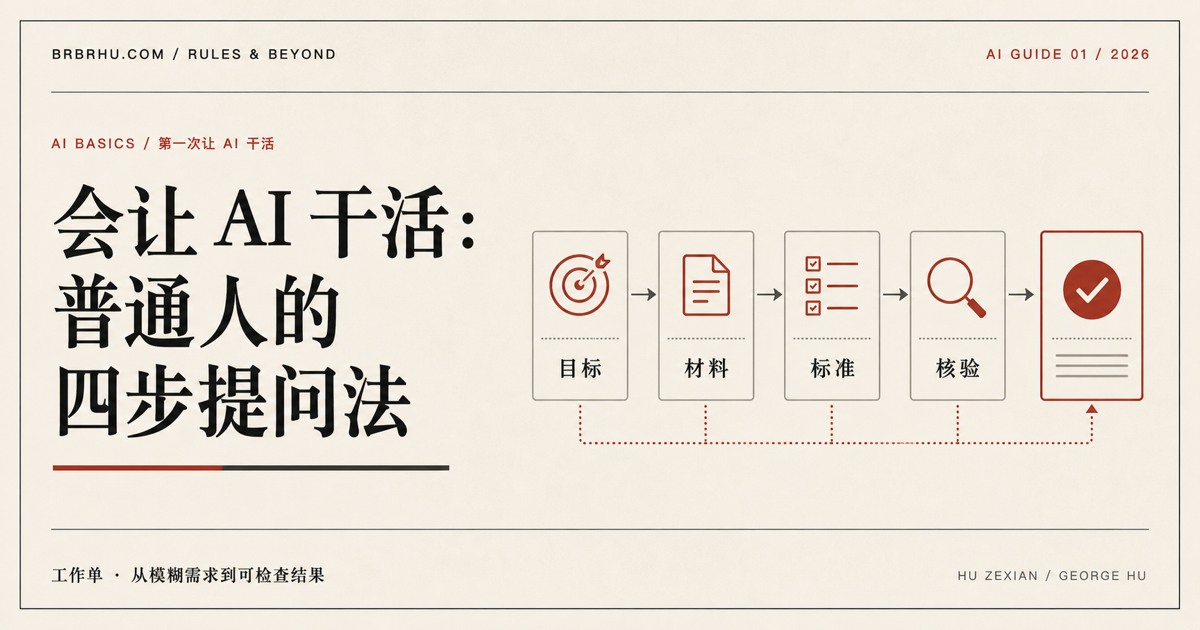
02 / WORK ORDERFour parts of an AI work order
Goal: what problem is being solved, who will use it, and what action should it enable. Materials: which source text, data, image or context must it rely on, and which facts may not be invented. Standard: length, format, tone, required content and exclusions. Verification: what proves completion, and which facts need a source, uncertainty label or human confirmation. The order is flexible; the result must make completion clear to both sides.
03 / PRACTICEA base instruction you can copy
State the job and who will use the result. Put the source materials between clear delimiters. Specify format, length, tone, required facts, and what must not be invented, disclosed or executed. Before completion, ask AI to identify missing material, separate fact from inference, list what still needs confirmation, and ask questions rather than fabricate details.
04 / PRACTICETurn a vague request into a task
Instead of “write a notice”, specify: notify all colleagues of a Friday 16:30 weekly meeting in the second-floor meeting room; each person submits one weekly progress item and one coordination issue by Friday 12:00. Ask for a Chinese group-message notice under 120 characters, direct and friendly, including time, place, action and deadline plus a copyable submission format. Then check those four facts before sending.
05 / PRACTICEDo not demand a perfect first answer
Treat prompting as iterative work. When output is vague, ask for one action that can be done tomorrow. When it is long, retain facts and actions, remove background, and cap it at 300 words. When the tone is wrong, say “like colleagues explaining work, not advertising or lecturing.” When information is mixed, ask for known facts, inferences and open items before drafting. Do not say “make it better”; name the gap, why it fails, and what passing looks like.
06 / VERIFYCheck whether AI got it right
AI can state errors confidently and invent quotations, dates or sources. Reopen originals to verify names, dates, numbers and quotations; recalculate with a spreadsheet, calculator or code; open real files to check pages, format and key content; and confirm an action actually happened. Asking AI to list claims, evidence, sources and uncertainty makes a useful checklist, but never replaces opening the source.
07 / PRACTICEWhat not to give directly to AI
Do not provide unapproved client material, case originals, identity numbers, accounts, passwords or codes; unredacted medical, financial, HR, contract or internal-meeting material; final actions that will be sent, published, paid, deleted or filed before line-by-line confirmation; or final professional judgments that a doctor, lawyer, accountant or another responsible professional must make. Redact identities, provide the minimum needed, use AI for sorting, comparison, drafting and checking, and leave adoption and execution to an authorized person.
08 / PRACTICEFinish your first exercise in 15 minutes
Pick one small task: summarize meeting notes, rewrite an email, or explain an unfamiliar concept. Write one line each for goal, material, standard and verification. Ask AI to restate the task and identify missing information. Generate a first version, mark one factual and one expression problem, give a specific second-round instruction, then open the source or file and decide whether the result is usable. You have moved AI from an answer machine into a workflow with inputs, standards and feedback.
Sources and verification
- OpenAI: effective prompting — clear instructions, context and iteration.
- Anthropic: Claude prompting best practices — explicit requirements and controlled output.
- Google: Gemini prompting strategy — clear instruction, input and examples.
- Verified July 26, 2026; products change, the method remains cross-tool.
Next: move from asking well to designing an AI job.
Use the four parts now on one real, checkable task.
Continue to AI Agents
READER COMMENTS
Leave the thought this article gave you.
No comments yet. You can leave the first one.